

In Baghdida (widely recognised as Iraq’s largest Christian city and a historic centre of Syriac Christianity) a three-day youth festival brought together more than 700 young Christians under the theme “In the Footsteps of Saint Francis.”
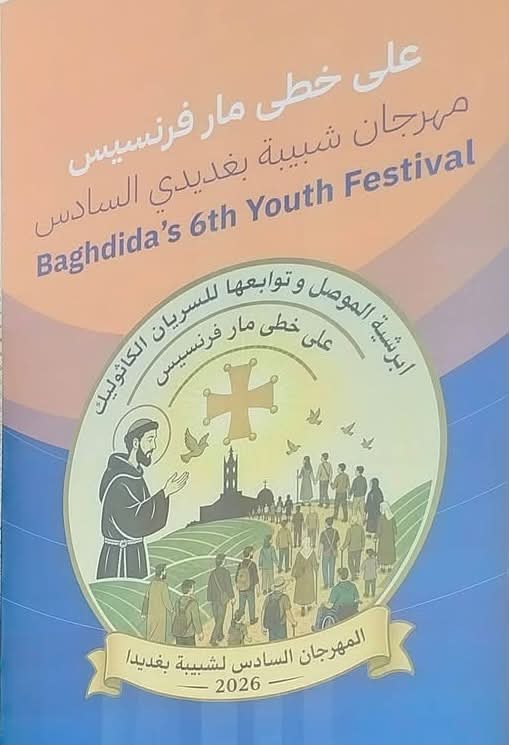
Through prayer, fellowship and visits to churches, the Baghdida Youth Festival celebrated faith, identity and community. It also carried a message extending far beyond the event itself: a generation whose families have endured persecution, displacement and profound loss remains deeply attached to its ancestral homeland and ready to contribute to Iraq’s future, provided it is afforded security, equal rights and genuine opportunities.
On the festival’s second day, participants travelled to Mosul, where they walked through its historic streets and visited its churches. The warm welcome extended by local Muslim residents offered a powerful image of social cohesion. It demonstrated that the goodwill shared by ordinary people remains stronger than the hatred promoted by small, ideologically driven extremist groups, sometimes encouraged by political interests and agendas from within and beyond the region.
The official welcome extended by the Governor of Nineveh also carried particular significance. It represented an important recognition of the belonging of Christian youth and their role in the province’s future. The value of this welcome will be strengthened if its message is translated into sustained policies and practical support for youth initiatives and local communities.
The visit to Mosul demonstrated that coexistence is neither a foreign concept nor merely a political slogan. It is a social reality that remains alive among ordinary people. Yet governments and political, social, cultural and religious institutions have not always invested sufficiently in these human bonds through genuine, institutional initiatives that rebuild trust and affirm that Christians are neither guests nor a community requiring temporary protection. They are indigenous people of the land and equal partners in its present and future.
The visit also carried profound historical meaning. For centuries, Christians were an integral part of Mosul’s social, cultural and economic life. When ISIS seized the city in 2014, its Christian population was forced to flee, while homes, businesses, churches and cultural heritage were destroyed, damaged or looted. Although Mosul was liberated in 2017, rebuilding physical structures is only one part of recovery. Lasting reconstruction also requires security, justice, equal citizenship, economic opportunity and renewed confidence in public institutions.
The festival proves that the desire to remain, rebuild and contribute is still alive. Resilience alone, however, cannot secure the future of any community. Political exclusion, discrimination, inadequate protection, unresolved property disputes and limited economic opportunities continue to place pressure on Christian families, leading many young people to see migration as their only path towards a secure future.
A family’s decision to remain in its homeland ultimately depends on confidence that its children can live safely, receive a quality education, find meaningful employment and participate equally in public life. Without these foundations, migration ceases to be simply a personal choice and becomes the almost inevitable consequence of policies that have failed to protect diversity or create the conditions necessary for stability.
This is where the international community has a responsibility to act (particularly Western governments, with Australia well placed to take a leading role) alongside development agencies and humanitarian organisations. Supporting Christians and other religious and ethnic minorities in Iraq and across the Middle East should not be limited to responding after crises occur. It should include preventive policies that address the drivers of displacement before they develop into new waves of migration.
Australia, with its experience in international development, community capacity-building and multiculturalism, can make an important contribution within a broader Western and international effort. Iraqi, Syriac, Chaldean and Assyrian communities in Australia and other Western countries can also serve as valuable bridges between international institutions and local communities, contributing their knowledge and experience to the design of initiatives that respond to people’s actual needs.
This requires sustained, locally led partnerships and investment in education, vocational training, employment, small businesses, youth leadership, and cultural and community institutions. Such efforts should be accompanied by support for property rights, religious freedom, political participation, equal citizenship and accountable governance.
Empowering religious and ethnic minorities and enabling them to remain safely and with dignity in their ancestral homelands is not only a humanitarian and human rights priority; it is also an investment in regional stability and the prevention of displacement. When members of these communities feel protected, enjoy equal citizenship and know that their children can study, work and participate in public life, the pressures driving them to leave are reduced.
This approach also serves the practical interests of Western countries, including Australia, as well as other refugee-hosting nations. Addressing the causes of displacement in countries of origin (through development, protection and support for local institutions) can help ease future pressure on asylum, migration and resettlement systems. Early investment in community stability is also more sustainable than waiting for persecution, poverty and insecurity to develop into large-scale humanitarian crises.
This does not mean closing the door to refugees or abandoning international protection for people whose lives remain at risk. It means adopting a balanced policy: protecting those who need a haven while giving those who wish to remain the means to make staying a safe, dignified and voluntary choice.
Christians in Iraq and the wider Middle East should not be viewed simply as communities awaiting evacuation. They are indigenous peoples with a rich history, a living culture and the capacity to contribute to the stability and development of their countries. Protecting them is not only about preserving religious diversity; it is also about safeguarding the model of pluralism that the region needs to confront extremism and division.
Through their festival and their visit to Mosul, the young people of Baghdida delivered a clear message: they want to remain, participate and help shape the future. What they need is more than sympathy. They need partnerships that transform resilience into opportunity, belonging into stability and hope into a viable future.
A meaningful response from Western governments (with Australia at the forefront) would turn shared humanitarian values into tangible action: supporting young people, empowering local communities, protecting diversity and addressing the root causes of displacement. Helping Christians and other indigenous communities build secure futures in their homelands is not only a moral responsibility; it is a strategic contribution to a more diverse and stable Middle East and a world less vulnerable to recurring crises of forced displacement.
Socio-Cultural Syriac Inc. Association 13 September 2026